
Managed IT Services vs. In-House IT: What Makes Sense for Your Bahamas Business
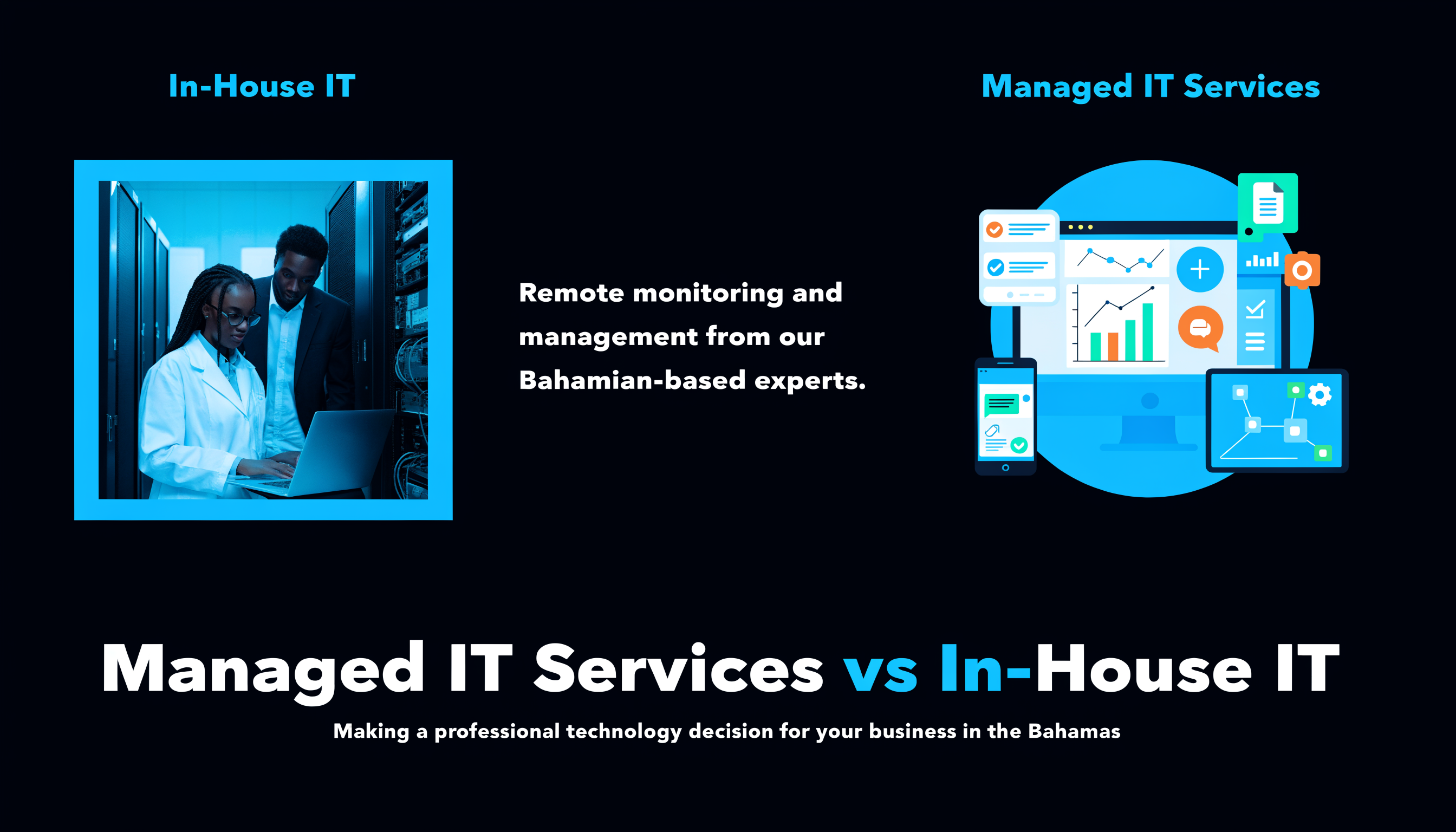
The $80,000 Question Every Growing Bahamian Business Faces
At some point, every growing business in The Bahamas faces the same decision: hire a full-time IT person, or outsource IT to a managed service provider (MSP)? The answer depends on factors specific to your business, industry, and technology complexity.
Defining the Options
In-House IT: Dedicated attention and deep institutional knowledge. Costs: entry-level IT technician $35,000-$50,000/year; experienced IT administrator $55,000-$80,000/year; senior IT manager $80,000-$120,000+. Plus benefits, equipment, training, and management overhead.
Managed Service Provider (MSP): A team of specialists at a fraction of the cost of hiring them individually. Services typically include helpdesk support, proactive monitoring, security management, backup management, and strategic IT planning. Cost: $75-$300/user/month depending on service level. For a 20-person business: $3,000-$6,000/month.
The Case for Managed IT Services
For most Bahamian businesses with fewer than 50 employees, managed IT services are typically the better choice:
- Breadth of expertise — No single IT hire can be expert in cybersecurity, networking, cloud platforms, and business applications. A good MSP brings specialists in each domain.
- Proactive vs. reactive — Problems are detected and resolved before they cause downtime. Unplanned downtime for a 20-person business at $50/hour = $4,000 in productivity loss per 4-hour outage.
- Predictable monthly costs — Converts IT from unpredictable capital expense to predictable operating expense.
- Cybersecurity depth — The threat environment changes constantly. A single in-house IT person cannot maintain the security knowledge required for modern business protection. Fortinet solutions provide enterprise-grade security managed by specialists.
When In-House IT Makes Sense
In-house IT is the right choice when: your technology is complex and business-critical with deep institutional knowledge requirements; you have more than 50-75 staff (cost math shifts); you're in a regulated industry with specific compliance requirements; or your operations require constant physical IT presence.
The Hybrid Model: Often the Best of Both Worlds
Many Bahamian businesses beyond 30-50 employees find the optimal answer is a hybrid: an in-house IT coordinator ($40,000-$55,000/year) who handles day-to-day requests and serves as the internal point of contact, plus an MSP for infrastructure management, cybersecurity, and escalated technical issues ($100-$150/user/month for specialist services only).
Questions to Ask Any MSP
- What is your response time SLA for critical issues?
- Do you have staff physically in The Bahamas?
- What cybersecurity services are included (not extras)?
- What is your disaster recovery capability?
- How do you handle data on your departure?
Digitize Bahamas Managed IT Services
Digitize Bahamas offers managed IT services for businesses across Nassau, Freeport, and the Family Islands — including helpdesk support, Fortinet-powered network management, cybersecurity, cloud services, backup and disaster recovery, vCIO services, and Zoho platform management.
If you'd like to evaluate managed IT services for your business, book a free IT assessment.
Tags
Ready to Transform Your Document & Records Management?
Get a free assessment and see how Docu Island can help your business
Get Free AssessmentRelated Articles
After the Rush: How to Use Technology to Learn from Your Peak Season
September is when Bahamian businesses exhale after tourist season. It's also the best time to use your data to understand what worked, what didn't, and what to do differently next year.
Aug 28, 2029How to Automate Your Accounts Receivable — And Get Paid Faster
Late payments are one of the most common and costly problems for Bahamian businesses. Accounts receivable automation doesn't just save time — it consistently reduces the time it takes to get paid.
Aug 14, 2029How to Digitize Your Business's Financial Records in 90 Days
Paper-based financial records are a liability — for audits, insurance claims, loan applications, and hurricane preparedness. Here's a practical 90-day plan to go fully digital with your financial documents.
Jul 17, 2029