
How Bahamian Hotels Can Use Technology to Compete with International Chains
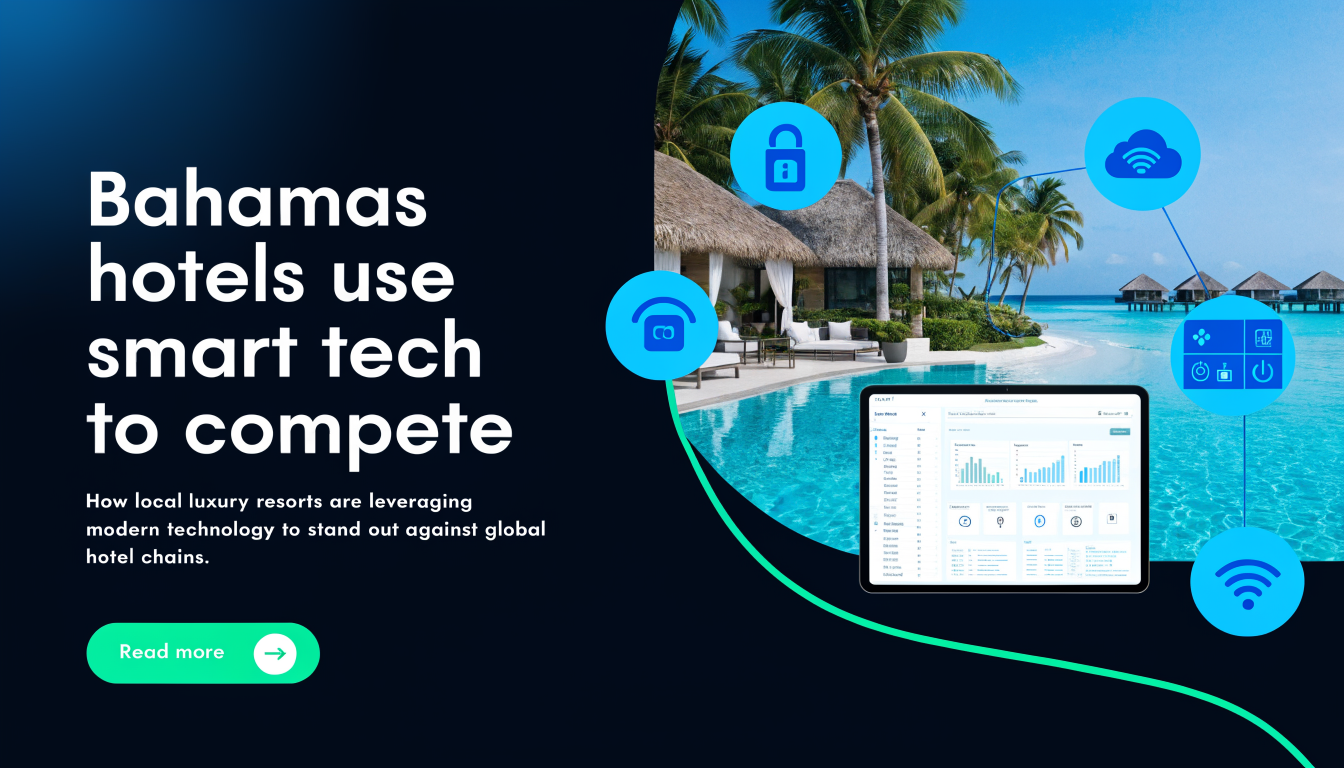
Walk into any Sandals or Atlantis property and the experience is seamless — from the app that unlocks your room to the system that remembers your drink order. Walk into many independent Bahamian hotels and you encounter something different: a binder at the front desk, a printed breakfast order form, and a staff member manually updating availability on three booking platforms at once.
The gap between international chains and local properties is not about service quality — Bahamian hospitality is world-class. The gap is about systems. And the good news is that those systems are now affordable, cloud-based, and available to any property on the island, regardless of size.
This guide breaks down the specific technologies that level the playing field, what each one costs, and how Bahamian hotel operators are implementing them without disrupting daily operations.
Why International Chains Have the Advantage (For Now)
Large chains invest heavily in technology infrastructure because the ROI is measurable. Every system they deploy serves one of four goals:
- Capturing more direct bookings (avoiding OTA commission fees of 15–25%)
- Increasing revenue per room through dynamic pricing and upselling
- Reducing operational costs through automation and better staff allocation
- Retaining guests through data-driven loyalty programmes
Independent Bahamian hotels have historically lacked access to these tools at an affordable price point. That changed over the past five years. Cloud-based software as a service (SaaS) models eliminated the large upfront technology cost, making enterprise-grade hotel systems accessible to a 12-room boutique property in Harbour Island or a 40-room hotel in Freeport.
The Core Technology Stack for a Competitive Bahamian Hotel
1. Property Management System (PMS)
The PMS is the operational backbone of any hotel. It handles reservations, check-in and check-out, room assignments, housekeeping coordination, and billing. Without a solid PMS, every other system in your hotel operates in isolation.
Modern cloud-based PMS platforms — such as Mews, Cloudbeds, or Opera Cloud — connect with every other system in your stack. A reservation made on Booking.com automatically updates availability across every channel, triggers a pre-arrival email, and assigns the guest to the appropriate room type. This happens without a staff member touching it.
For Bahamian hotels specifically, look for a PMS that:
- Operates fully in the cloud (critical for hurricane resilience — local servers get destroyed)
- Handles multi-currency billing (USD and BSD)
- Offers mobile access so staff can manage operations from anywhere on property
- Integrates with Bahamian payment processors
Implementation timeline: 4–8 weeks for a typical property, including staff training.
2. Channel Manager
If you list your property on Booking.com, Expedia, Airbnb, and your own website simultaneously, managing availability manually is a losing battle. Double bookings are not just embarrassing — they have legal and financial consequences.
A channel manager connects your PMS to every booking platform and synchronises availability, rates, and restrictions in real time. When a room is booked on Airbnb, it disappears from every other platform instantly. When you run a weekend promotion, all platforms update simultaneously.
The hidden benefit: channel managers give you data on where your bookings are coming from, which lets you reduce dependence on high-commission platforms over time and shift more guests to direct booking.
3. Booking Engine
Your hotel website is your most profitable booking channel if — and only if — guests can actually book directly through it. A booking engine embeds reservation functionality into your site, processes payments securely, and confirms the booking without human involvement.
International chains spend millions driving traffic to their direct booking sites. As an independent property, you can replicate the mechanism if not the budget. A professional booking engine with a clean guest experience, clear cancellation policies, and a rate match guarantee can shift 20–30% of your OTA bookings to direct, saving thousands of dollars per month in commission fees.
4. Guest Communication Automation
From the moment a guest books to the moment they check out, most of the communication is predictable and repeatable. International chains automate this entirely. You can too.
A guest messaging system sends:
- Booking confirmation with property information and arrival instructions
- Pre-arrival message with local tips, weather, and upsell offers (early check-in, airport transfer, spa packages)
- Check-in day greeting with room-ready notification
- Mid-stay check-in to resolve any issues before checkout
- Post-stay review request (timed to appear within 24 hours of departure, when the experience is fresh)
This sequence, properly implemented, measurably increases online reviews, reduces complaint escalations, and generates ancillary revenue from upsells — with no additional staff time.
5. Revenue Management
International chains employ revenue managers whose full-time job is adjusting room rates based on demand signals — local events, competitor pricing, historical patterns, booking pace. Independent hotels almost never have this function.
Revenue management software makes it accessible. These tools monitor market data and competitor rates automatically, then suggest (or automatically adjust) your pricing to maximise revenue. A 10% improvement in revenue per available room (RevPAR) on a 30-room property generating $500 per night is $1,500 per day — $547,500 per year.
During peak season — Christmas, spring break, Junkanoo — these tools ensure you are not underpricing relative to what the market will bear. During shoulder season, they help fill rooms at rates that still cover operating costs.
6. CRM and Loyalty Programme
Every guest who stays at your property is a potential repeat visitor and referral source. International chains have loyalty programmes specifically to capture this relationship — and the data behind it. When a guest returns to a Marriott, the system knows their room preferences, dietary restrictions, and favourite activities before they arrive.
A hotel CRM (Customer Relationship Management system) stores guest profiles, stay history, and preferences. Combined with an email marketing platform, it lets you stay in contact after checkout, offer returning guests a loyalty rate, and personalise the experience on their next visit.
In a market like The Bahamas, where word-of-mouth drives significant bookings and repeat visitors can account for 30–40% of revenue, a CRM is not a luxury — it is a competitive necessity.
The Compliance Angle: Data Protection
One issue Bahamian hotel operators often overlook: guest data is sensitive data. Credit card numbers, passport details, arrival information — this all flows through your systems. International chains have legal teams and IT departments to manage this. You need to ensure your technology partners are:
- PCI-DSS compliant for payment processing
- Storing guest data on secure, encrypted servers
- Operating under appropriate data protection frameworks
This is one reason to work with a local technology partner rather than implementing systems independently. A consultant who understands the Bahamian regulatory environment can flag compliance issues before they become problems.
What Does Implementation Actually Cost?
The total technology investment for a fully-equipped independent hotel varies by property size, but a rough guide for a 20–50 room property:
- PMS: $200–$600/month (cloud subscription, scales with room count)
- Channel Manager: $100–$300/month
- Booking Engine: Often bundled with PMS or $50–$150/month standalone
- Guest Messaging: $50–$200/month
- Revenue Management: $200–$500/month or commission-based on revenue upside
- CRM/Email Marketing: $50–$200/month
Total: approximately $600–$1,950 per month. Compare this to the commission fees on a single slow month of OTA bookings — at 20% commission on $20,000 in OTA revenue, you are paying $4,000 to the platforms alone. The technology pays for itself quickly.
Where to Start: A Phased Approach
Trying to implement every system simultaneously is a recipe for disruption. A phased approach works better:
Phase 1 (Month 1–2): PMS and Channel Manager. These are the foundation. Everything else builds on them. Get these right before adding anything else.
Phase 2 (Month 2–3): Booking Engine. Once your PMS is stable, activate direct booking. Review your website and ensure it is optimised for conversion.
Phase 3 (Month 3–4): Guest Communication. Automate the guest journey from confirmation to post-stay review. This is high-impact and relatively low-complexity to implement.
Phase 4 (Month 4–6): Revenue Management and CRM. Once the operational systems are stable, layer in the revenue optimisation and retention tools.
The Real Competitive Advantage
International chains win on systems, but local hotels can win on something the chains cannot replicate: authentic Bahamian experience delivered by people who actually live here. Technology does not replace that. It frees up your staff to focus on what guests actually remember — the personal interactions, the local knowledge, the genuine warmth.
When a front desk agent is no longer manually updating spreadsheets, they can have a real conversation with the guest. When housekeeping is coordinated by software, the manager can focus on quality control rather than scheduling logistics. Technology handles the transactional; your team handles the experiential.
That combination — world-class systems plus authentic local service — is something no international chain can match at a Bahamian property run by Bahamians.
Not Sure Where to Start with Hotel Technology?
Book a Free Digital Growth Audit with the Novio Group team. We assess your current systems, identify the highest-impact gaps, and give you a prioritised roadmap for upgrading your property's technology — at no cost and no obligation.
Schedule Your Free Digital Growth Audit
Tags
Ready to Transform Your Document & Records Management?
Get a free assessment and see how Docu Island can help your business
Get Free Assessment