
The Bahamian Business Owner's Guide to Zoho One
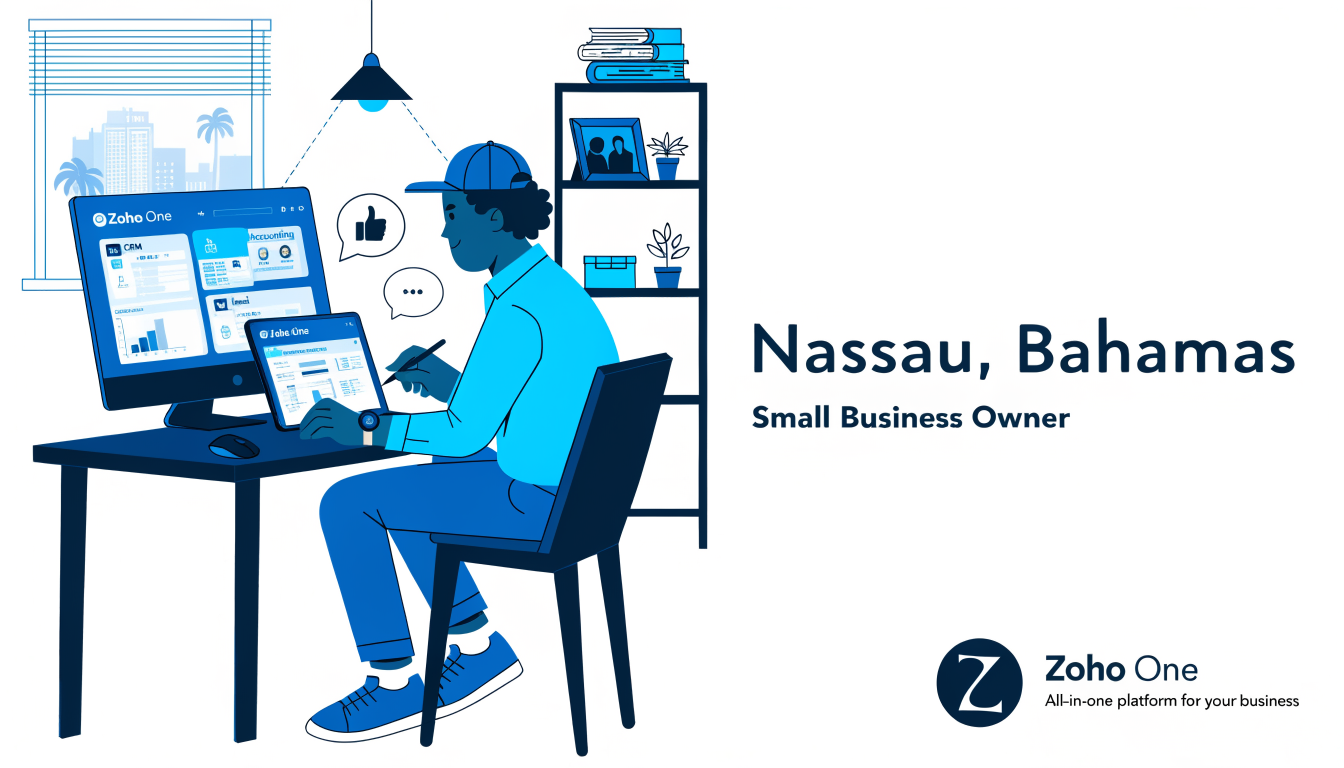
Most Bahamian small and medium businesses are running on a patchwork of disconnected tools: one system for accounting, a different one for customer contacts, spreadsheets for HR, WhatsApp for internal communication, and someone's personal Gmail for business email. Each tool works in isolation. Information doesn't flow between them. Staff waste hours re-entering the same data into multiple places. And when something goes wrong — a missed invoice, a lost customer inquiry — nobody can trace what happened or when.
Zoho One is a business operating system that replaces this chaos with a single, integrated platform. For around $35 to $45 USD per user per month, you get access to more than 45 applications covering every function of your business — and they all share the same data, the same customer records, and the same underlying logic.
This guide explains what Zoho One includes, how it compares to buying software separately, which Bahamian businesses are the best fit, and what implementation actually looks like.
What Is Zoho One?
Zoho is an Indian-founded software company with more than 100 million users worldwide. Unlike US-based software giants, Zoho is entirely self-funded — no venture capital, no outside investors — which means its pricing decisions are driven by long-term customer relationships rather than quarterly earnings targets. That philosophy shows up in the price: Zoho One consistently offers the best value-per-feature of any business software suite on the market.
Zoho One bundles these applications (among others) into a single subscription:
Sales and CRM
- Zoho CRM — track leads, manage the sales pipeline, automate follow-ups
- Zoho SalesIQ — live chat and visitor tracking for your website
- Zoho Campaigns — email marketing to prospects and customers
- Zoho Survey — customer feedback and Net Promoter Score
Finance and Accounting
- Zoho Books — invoicing, expenses, bank reconciliation, VAT/tax reporting
- Zoho Inventory — stock management, purchase orders, fulfilment
- Zoho Expense — employee expense claims and approvals
- Zoho Payroll — payroll processing with local compliance rules
HR and People
- Zoho People — employee records, leave management, performance reviews
- Zoho Recruit — job postings, applicant tracking, onboarding
Productivity and Collaboration
- Zoho Mail — professional email at your domain (no more Gmail for business)
- Zoho Cliq — team messaging and video calls
- Zoho Projects — project management with tasks, timelines, and dependencies
- Zoho WorkDrive — secure cloud file storage and collaboration
- Zoho Sign — legally binding e-signatures on contracts and documents
Marketing and Customer Service
- Zoho Desk — customer support ticketing and help desk
- Zoho Social — social media scheduling and monitoring
- Zoho Marketing Automation — advanced lead nurturing workflows
The Real Cost Comparison
Let's do the maths. If a typical Bahamian SME were to buy the equivalent functionality as standalone products from different vendors:
- Salesforce CRM: $75/user/month
- QuickBooks Online: $50/month (company-wide)
- BambooHR: $8–$12/user/month
- Google Workspace: $12/user/month
- Mailchimp: $20–$100/month
- Zendesk: $55/user/month
- DocuSign: $40/user/month
For a 10-person business, that's easily $500–$800/month — and none of these systems talk to each other. Zoho One for 10 users is approximately $350–$450/month, and everything is integrated from day one.
But the bigger saving is not the subscription cost. It is the time. When your CRM automatically creates an invoice in Zoho Books when a deal closes, when your support ticket automatically links to the customer's CRM record, when your accountant can see exactly which deals generated which invoices — that is hours of manual work eliminated every single week.
Who Is Zoho One Best For?
Zoho One is an excellent fit for:
- Professional services firms (accounting, legal, consulting, architecture) that manage client relationships and projects simultaneously
- Retail and distribution businesses that need inventory, invoicing, and customer management in sync
- Tourism and hospitality operators managing bookings, expenses, and customer communications
- Healthcare clinics and wellness centres that need secure patient records, appointment scheduling, and billing
- Construction and contracting firms that track projects, expenses, and subcontractor relationships
Zoho One is not the right fit for businesses with very specialised industry-specific requirements — a highly regulated financial institution or a manufacturing operation with complex production workflows may need purpose-built ERP software. For most Bahamian SMEs, though, Zoho One covers 90–95% of their software needs out of the box.
The Bahamian Context: What to Watch For
Implementing Zoho One in The Bahamas comes with a few specific considerations that a generic Zoho reseller will miss:
Localisation for Bahamian Tax and Compliance
Zoho Books needs to be configured for Bahamian VAT rules (12% VAT, zero-rated categories, VAT return format required by the Department of Inland Revenue). Out of the box, it is not pre-configured for The Bahamas — this requires setup work. An experienced local partner handles this during implementation.
Data Residency
Zoho's servers are distributed globally. For businesses with data sovereignty concerns (legal firms, healthcare providers, regulated financial businesses), you can request that data be hosted in a specific region. This requires configuration at the account setup stage.
Integration with Bahamian Banks
Zoho Books supports bank feeds from many international banks. Direct feed integration with Bahamian institutions (CIBC FirstCaribbean, Bank of The Bahamas, Commonwealth Bank) may require manual export/import or intermediary tools. Your implementation partner should assess this during discovery.
Internet Reliability
Zoho is cloud-based, which means it requires a reliable internet connection. For offices in areas with less consistent connectivity, a hybrid approach — using Zoho's mobile apps with offline sync capabilities — may be required. Hurricane season planning should include what happens if connectivity is lost for multiple days.
What Does a Zoho One Implementation Look Like?
A properly managed Zoho One implementation has four phases:
Discovery (Week 1–2): Understanding your current processes, data sources, and the specific workflows you want to automate. This phase is about understanding your business before touching any software.
Configuration (Week 2–4): Setting up your Zoho environment — chart of accounts in Books, pipeline stages in CRM, email templates, automation rules, user permissions. This is where local expertise matters most.
Data Migration (Week 3–5): Moving your existing customer records, financial history, and documents into Zoho. A clean migration requires data auditing before import — garbage in, garbage out.
Training and Go-Live (Week 5–8): Training your team on the specific workflows they'll use daily, followed by a managed go-live period where support is available for questions and adjustments.
Most Bahamian SME implementations take six to ten weeks from kick-off to full production. Attempting to implement Zoho One without a local partner typically takes three to four times longer and often stalls completely when the business runs into configuration issues they cannot resolve.
The Integration Advantage
The reason businesses switch to Zoho One — and stay — is the integration. A real example of what this looks like in practice:
A prospect fills out a form on your website. Zoho SalesIQ captures their information and creates a lead in Zoho CRM. Your salesperson is notified automatically and follows up. When the deal closes, Zoho CRM triggers Zoho Books to generate the invoice. The client signs the contract via Zoho Sign. Zoho Projects creates the project with tasks for your delivery team. Zoho People logs the time worked. Every system is updated with zero manual re-entry.
This is not futuristic technology. It is available today, configured correctly, for a few hundred dollars a month.
Ready to See If Zoho One Is Right for Your Business?
Novio Group is an authorised Zoho partner based in Nassau. We assess your current systems and workflows, then show you exactly what Zoho One would look like for your specific business — before you commit to anything. Book a Free Digital Growth Audit to get started.
Book Your Free Digital Growth Audit
Tags
Ready to Transform Your Document & Records Management?
Get a free assessment and see how Docu Island can help your business
Get Free Assessment